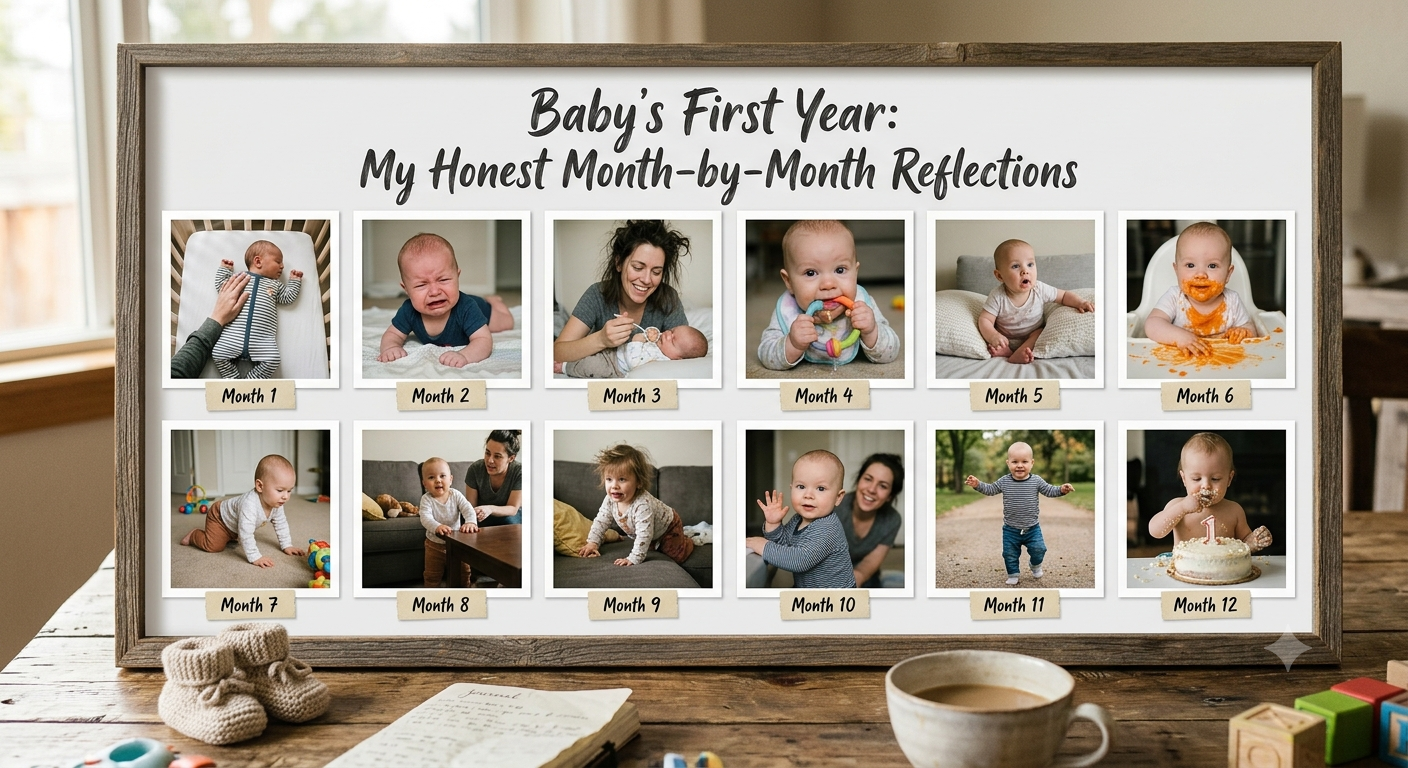
Baby’s First Year :Let me start with something I don’t usually say at the beginning of a review: I’m exhausted.
Not because I’m writing this at 3 AM. But because I’ve been up with a baby who decided sleep was optional tonight. And honestly? That’s exactly why I wanted to write this.
When my first child was born, I was lost. I had read the books, scrolled through the forums, and asked every parent I knew for advice. But nothing—and I mean nothing—truly prepared me for the whirlwind of the first year.
I spent months documenting every milestone, every sleepless night, every moment of pure, heart-melting joy. What I found surprised me. The first year isn’t just about your baby’s development. It’s about yours too.
Let me walk you through what I discovered—month by messy, beautiful month.
Why I Started Paying Attention to the First Year
I’ll be honest. Before having kids, I thought I understood what the first year was about. Feed, sleep, change diapers, repeat. How hard could it be?
Then I brought my daughter home from the hospital.
The first night, I sat in the nursery at 2 AM, holding a crying baby, wondering if I was doing everything wrong. The books said she should sleep. She wasn’t sleeping. The books said she should feed every three hours. She wanted to feed every 45 minutes. Nothing was going according to plan.
That’s when I realized something important. The first year isn’t a checklist to complete. It’s a journey to experience. Every baby is different. Every family is different. And that’s okay.
The most important thing isn’t hitting every milestone exactly on schedule. It’s being present. Being patient. And giving yourself grace when things don’t go perfectly.
Month 1: The Newborn Phase
“I loved the very first sigh. It was like she knew she was safe in my arms.” – Kurin Riopel
The first month is about survival. For you and your baby. Those first weeks are a blur of feedings, diaper changes, and sleep deprivation that defies explanation.
Your baby is adjusting to life outside the womb . They’re born with powerful survival skills: the rooting and sucking reflex, the ability to turn their head away from an object blocking their airways, a fascination with faces (despite blurry vision) that helps cement the bond with you, and a powerful, galvanizing cry .
At this stage, most babies sleep the majority of the time . They’ll be awake for short periods to feed, and they’ll cry to communicate their needs—hunger, discomfort, or simply wanting to be held.
What I Learned:
My daughter spent most of her first month curled up in a tight ball, recreating her position in the womb. I remember being concerned that she never seemed to stretch out. But it turns out, the close confinement of the last month of pregnancy tightens their ligaments, so lying stretched out doesn’t come easily at first .
The first month is also about you adjusting. Your home, your schedule, your entire life revolves around this tiny person. And that’s okay. Give yourself permission to do nothing but care for your baby and yourself.
Tips from Experience:
- Trust your instincts. You and your baby are learning together.
- Accept help. When someone offers to bring food or hold the baby so you can shower, say yes.
- Take photos. You’ll want to remember those tiny fingers and toes.
- Sleep when the baby sleeps (yes, it’s cliché, but it works).
Month 2: The First Smile
“My eldest was a very solemn baby and broke into her first smile on my first Mother’s Day at exactly two months old.” – Tracy Chappell
Month two is when things start to get interesting. Your baby is more alert, more aware of the world around them. And the crying peaks around six to eight weeks .
But here’s the magic: sometime around now, you’ll see their first real smile. Not the fleeting, accidental smile of a newborn, but a beaming smile of pure pleasure . It changes everything.
Your baby is also starting to make their first vowel sounds and cooing, which is an exciting milestone in language development .
What I Learned:
The first time my daughter smiled at me, I cried. I had been exhausted, overwhelmed, and wondering if I was doing anything right. That smile told me everything I needed to know. She knew me. She was happy to see me. I was her person.
Tips from Experience:
- Talk to your baby constantly. They love hearing your voice.
- Try babywearing. It can provide comfort and reduce crying .
- Start reading to your baby. Choose books with bright pictures .
Month 3: Laughter and Interaction
“Her first laugh was at some silly sounds my husband would make. There is no better sound than her laugh.” – Andrée Raymond
By three months, your baby is already so different from their newborn self . Their body has relaxed, their hands have opened, and they’re starting to reach for toys .
This is also the month when you might hear their first laugh. And I can tell you from experience, there’s truly no better sound .
Your baby is also getting better at tummy time, lifting their head and chest . They’re becoming more interactive, responding to your voice and face with smiles and coos .
What I Learned:
I spent hours making silly faces and sounds to get my daughter to laugh. It became my mission. And when that first laugh came, it was like music. I recorded it on my phone and played it on repeat for weeks.
Tips from Experience:
- Introduce colorful toys to encourage visual tracking .
- Make faces and sounds to encourage interaction.
- Continue tummy time to build neck and upper body strength.
- Don’t be afraid of making a fool of yourself. Your baby loves it.
Month 4: The Golden Age
Month four is often called one of babyhood’s “golden ages” . Most four-month-olds are passionately in love with you but not yet standoffish with strangers, eager to explore the world but not yet mobile enough to “get into everything.”
Your baby is developing a sense of their own body. They’ll start looking at their hands, almost as if they’re thinking, “Where did this thing come from?” . And once they discover their hands, they’ll bring them to their mouth and start exploring everything with their tongue .
What I Learned:
The fourth month was when I really started to see my daughter’s personality emerge. She was curious, determined, and had a strong sense of humor. She also started giggling and squealing, which was absolutely delightful.
Tips from Experience:
- Talk to your baby constantly. They love hearing your voice .
- Introduce safe toys for them to grasp and explore.
- Respond to their sounds and giggles. You’re teaching them that communication works.
- Take lots of videos. The sounds they make at this age are precious.
Month 5: Reaching and Rolling
“At five months, my daughter started to roll over. My eyes were full of tears—I was such a proud mommy.” – Sara Stewart
By five months, your baby can reach out and grab something with one hand, with pretty good aim. With plenty of tummy time, they can probably do a baby “pushup,” holding the front half of their body off the ground .
Your baby has also likely doubled their birth weight by now . They’re starting to communicate desires through body language, like reaching for things or grasping at you because they want to be picked up .
What I Learned:
The first time my daughter rolled over, I was in the other room. My husband called out, “Did you see that?” I ran in, and of course, she was lying on her back, looking innocent. But I was so proud. And I also realized: time to babyproof.
Tips from Experience:
- Babyproof your home. Your baby is about to become mobile .
- Introduce teething rings. This is when teething often starts .
- Play games like peek-a-boo to develop object permanence.
Month 6: Solid Foods and Mobility
“When I go in after nap time, my son goes up on his hands and knees, and looks at me with the biggest smile on his face. It melts my heart every time.” – Allison Sewell
Six months is a huge milestone month. Your baby is likely ready to start solid foods. They’re watching your food intently as it moves from plate to mouth, even smacking their lips in imitation .
They’re also pushing their bodies up into a crawling position and may be crying out for attention when you leave the room . Once they learn to pull their knees under their body, mobility has arrived .
What I Learned:
Introducing solids was both exciting and terrifying. The first spoonful of pureed sweet potato ended up everywhere except in my daughter’s mouth. But she loved it. The mess was worth it to see her excitement.
I also realized that once she could move, nothing was safe. The days of leaving her on a blanket while I grabbed something from the kitchen were over.
Tips from Experience:
- Start with single-ingredient purees .
- Be patient. It takes time for babies to learn to eat.
- Continue tummy time and encourage movement.
- This is the time to really babyproof. They’re about to get fast.
Month 7: Teeth and Sitting
By seven months, it’s likely that your baby’s first tooth has appeared . Teething can be an uncomfortable period, with babies looking for objects to chew to alleviate the pain.
Most seven-month-old babies can now sit unsupported and will crawl or shuffle when placed on the floor . They can transfer objects from one hand to the other, and they know their own name and look up when you call them .
What I Learned:
Teething was rough. My daughter was cranky, drooling constantly, and chewing on everything in sight. Frozen teething rings became our best friend. But through it all, she was still curious and determined, practicing sitting and figuring out how to move.
Tips from Experience:
- Offer teething rings, especially cold ones .
- Create a safe area for your baby to explore.
- Talk to your baby using their name. They’ll respond.
- Celebrate every milestone, no matter how small.
Month 8: Separation Anxiety
“He had a real determination about him. When he wanted to crawl, he started that rocking back and forth and then took off.” – Kathleen Finlay
Two key things have happened by eight months: your baby can now get themselves where they want to go, and they’ve grasped the concept of object permanence . They realize that when you disappear from sight, you’re still somewhere.
But here’s the rub: separation anxiety . It can be stifling, but it just means your baby really, really loves you. In time, they’ll learn that you always come back and saying goodbye will be easier .
Your baby is also likely crawling by now, grasping things with their thumb and first two fingers, and responding to “No” by pausing or stopping their activity .
What I Learned:
The separation anxiety hit hard. My daughter would cry when I left the room, and I felt guilty every time I needed to step away. But I realized this was normal—a sign of secure attachment. She knew I was her safe person.
Tips from Experience:
- Develop goodbye rituals .
- Play peek-a-boo to reinforce that you always come back.
- Encourage independent play with safe toys.
- Be patient. This phase passes.
Month 9: Pulling Up and Pincer Grasp
Nine-month-old babies can grasp foods and are working hard on developing the coordination to feed themselves . They may be pulling themselves into an upright position and may also be taking supported steps .
They can understand simple instructions and are likely to understand their own names . They also develop the “pincer grip,” picking up tiny objects between thumb and forefinger .
What I Learned:
The pincer grip was both impressive and terrifying. My daughter could pick up individual pieces of food—and then everything else she found on the floor. Babyproofing went to a whole new level.
Tips from Experience:
- Create a safe area for practicing standing and cruising.
- Provide blocks for stacking and toys for grasping .
- Offer finger foods to practice self-feeding.
- Watch for dropped objects—they’ll now be throwing things on purpose .
Month 10: Cruising and Communication
At ten months, your baby is quickly gaining confidence. Even though they might not be able to walk, if they’ve started crawling, they can move quite rapidly and may even try to climb stairs .
They can communicate back to you using signs or body language, and it’s exciting to watch them process your words . They’re also starting to understand that things exist even when they’re out of sight .
What I Learned:
This was the month my daughter became a copy-cat. I’d tap the table, and she’d tap it too. I’d make a funny face, and she’d try to copy me . It was amazing to see her learning through imitation.
Tips from Experience:
- Encourage cruising by placing toys just out of reach.
- Play interactive games like peek-a-boo.
- Copy their sounds and actions. It’s how they learn.
- Be patient if they’re not walking yet. Every baby develops at their own pace.
Month 11: On the Verge
On the verge of walking, on the verge of talking, on the verge of eating “big people” food—the world is opening up for the nearly one-year-old .
Your baby may already say “Mama,” “Dada,” or a sibling’s name. They’ve probably made the fascinating discovery that small things can fit inside bigger things: filling, dumping, and pouring will be a favorite activity for months to come .
What I Learned:
The house became a constant mess. Toys were everywhere—dumped out of baskets, thrown across the room, and scattered in every corner. But I learned to embrace the chaos. It was a sign of exploration and discovery.
Tips from Experience:
- Provide stacking toys, nesting rings, or cups .
- Encourage exploration in a safe environment.
- Celebrate every new word, even if it’s just a sound.
- Start preparing for the big birthday.
Month 12: Happy Birthday
“For my first son I made this elaborate birthday cake. But with Matias, we just had carrot cupcakes and left it at that. He loved it!” – Kathleen Finlay
In 12 short months, a tiny, helpless newborn has transformed into this busy, bright toddler . Look at all they can do: pull themselves to a stand, crawl up stairs, feed themselves, stack and throw toys, imitate sounds and gestures, understand several words, and maybe say a couple .
They’ve come a long way. And just wait till you see what they get up to next year .
What I Learned:
My daughter’s first birthday was emotional. I couldn’t believe how much she’d grown and changed in just one year. And I couldn’t believe how much I’d grown too. I was a different person—more patient, more loving, more tired, but so much more fulfilled.
Tips from Experience:
- Celebrate the milestone with cake (and let them make a mess).
- Take comparison photos with the same background as the newborn photos .
- Reflect on your journey. You’ve both come so far.
- Start looking forward to year two—it’s going to be even more exciting.
Key Milestones Overview
For quick reference, here are the key milestones I observed:
Common Concerns and When to Seek Help
It’s normal to worry. Here are some signs that may warrant a conversation with your pediatrician :
- Baby is not responding to sounds or visual stimuli in the first month
- Baby is not sitting or crawling by 10 months
- Limited social interaction such as lack of smiling or eye contact at any milestone
Trust your instincts. If something feels off, talk to your doctor. Early intervention can make a significant difference .
My Honest Advice for New Parents
Here’s what I wish I’d known going into the first year:
1. Every Baby Is Different
The milestones in this article are averages. Your baby will hit some early and others late. That’s normal. The important thing is progress over time, not perfection .
2. You Can’t “Do It Wrong”
Parenting is not a test. There’s no right way to do it. Trust your instincts, listen to your baby, and give yourself grace when things don’t go perfectly.
3. The Hard Phases Are Temporary
The sleepless nights, the teething, the separation anxiety—they all pass. Sometimes it feels like they’ll never end, but they do.
4. Document Everything
Take photos, take videos, write down the moments you want to remember . The first year goes faster than you can possibly imagine.
5. Take Care of Yourself
You can’t pour from an empty cup. Rest when you can, accept help when it’s offered, and give yourself permission to do less.
6. It Gets Easier
Not in the sense that parenting ever becomes easy. But you become more confident. You learn your baby. You figure out what works for your family.
Final Verdict
The first year is a whirlwind. It’s exhausting, emotional, and sometimes overwhelming. But it’s also beautiful, joyful, and transformative.
In 12 months, your tiny, helpless newborn transforms into a busy, curious toddler with opinions, humor, and willpower. And you transform too—into a parent who knows their baby better than anyone else in the world.
If you’re in the middle of the first year right now, take a deep breath. You’re doing better than you think. Enjoy the small moments—the first smile, the first laugh, the first steps. They’ll be gone before you know it.
And remember: your baby doesn’t care if you’re perfect. They just care that you’re there.
Disclaimer: This article is based on my personal experience and research. It is not a substitute for professional medical advice. Always consult your pediatrician with any concerns about your baby’s development. Every baby is unique and reaches milestones at their own pace.
