Teaching Kids About Emotions Through Play :Let me start with something I don’t usually say at the beginning of an article: I wish I’d known this sooner.
Not because I didn’t love my kids. But because I spent way too many years trying to explain emotions to them instead of playing through them. I’d say things like, “Use your words” or “Take a deep breath,” and then wonder why it wasn’t working.
Here’s what I finally figured out: children don’t process emotions the way adults do. They don’t learn by listening to lectures. They learn by doing, feeling, and playing.
I spent months researching emotional development in children—talking to educators, reading studies, and most importantly, testing these approaches with my own kids. What I found changed everything. And I think it might change everything for you too.
Let me walk you through what I discovered.
Why Play Matters for Emotional Intelligence
Here’s the thing about kids and emotions: they’re experiencing huge feelings with very little vocabulary to describe them. Imagine feeling furious but only having the word “mad.” Or feeling anxious but not knowing what that even means.
Emotional intelligence isn’t something children are born with. It’s something they develop over time through experience and guidance . And the most effective way to help them develop it? Through play.
Research consistently shows that playful activities are among the most powerful tools for building emotional skills. Studies have found that structured play-based interventions can significantly improve emotional awareness, empathy, and self-control in young children .
A 2025 study on preschool-aged children found that play-based methods—including role-playing, storytelling, art activities, and drama—are the most effective approach for developing emotional intelligence. Children who engage in these activities learn to recognize emotions, express feelings appropriately, and understand the emotional states of others .
The Four Key Benefits:
- Play is natural for kids. They don’t feel like they’re “learning.” They feel like they’re having fun.
- Play creates emotional safety. When kids are playing, they’re more willing to explore difficult feelings.
- Play builds vocabulary naturally. Through stories, games, and role-play, children learn the words for their feelings.
- Play builds empathy. When children act out different emotions, they literally practice seeing the world from someone else’s perspective.
The Building Blocks of Emotional Play
Before we get into specific activities, let’s talk about what we’re actually trying to build. I’ve found that emotional development through play focuses on five key areas :
1. Self-Awareness
Helping children recognize their own emotions. What does anger feel like in their body? How do they know when they’re sad?
2. Self-Management
Learning to regulate emotions. What can they do when they feel overwhelmed? How do they calm down?
3. Social Awareness
Understanding other people’s emotions. How can they tell if a friend is sad? What does empathy look like?
4. Relationship Skills
Building healthy connections. How do they share, cooperate, and resolve conflicts?
5. Responsible Decision-Making
Making thoughtful choices. What happens when they act out of anger versus acting with intention?
Activities for Babies and Toddlers (Ages 0-3)
You might think emotional learning starts when kids can talk. It doesn’t. It starts from day one.
The good news is you don’t need fancy activities. Social-emotional learning happens naturally through daily interactions . When you hug your baby, play peek-a-boo, make silly faces, or sing a lullaby, you’re building skills like bonding and emotional expression.
What to Do:
Use Books with Emotion Talk
When you read board books together, point out facial expressions. Say things like, “That girl looks sad,” or “Those little pigs look scared.” Make the faces yourself—show your baby what sad or scared looks like .
Sing Emotion Songs
Music is powerful for little ones. Sing “If You’re Happy and You Know It” and actually act out the emotions. Watch “When You Feel So Mad” from Daniel Tiger together. Music keeps short attention spans engaged while teaching about feelings .
Encourage Peer Play
When babies play together, they learn essential skills like nonverbal communication and cooperation. Even if they’re just sitting near each other, those interactions matter .
What I Learned:
My daughter didn’t understand the word “frustrated” at 18 months. But when I sang the Daniel Tiger mad song and showed her what frustration looked like, she started making the same face when she felt that way. She wasn’t speaking in complete sentences, but she was learning to communicate her feelings.
Activities for Preschoolers (Ages 3-5)
This is the golden age for emotional play. Preschoolers are developing language quickly, love imaginative play, and are starting to understand that other people have feelings too.
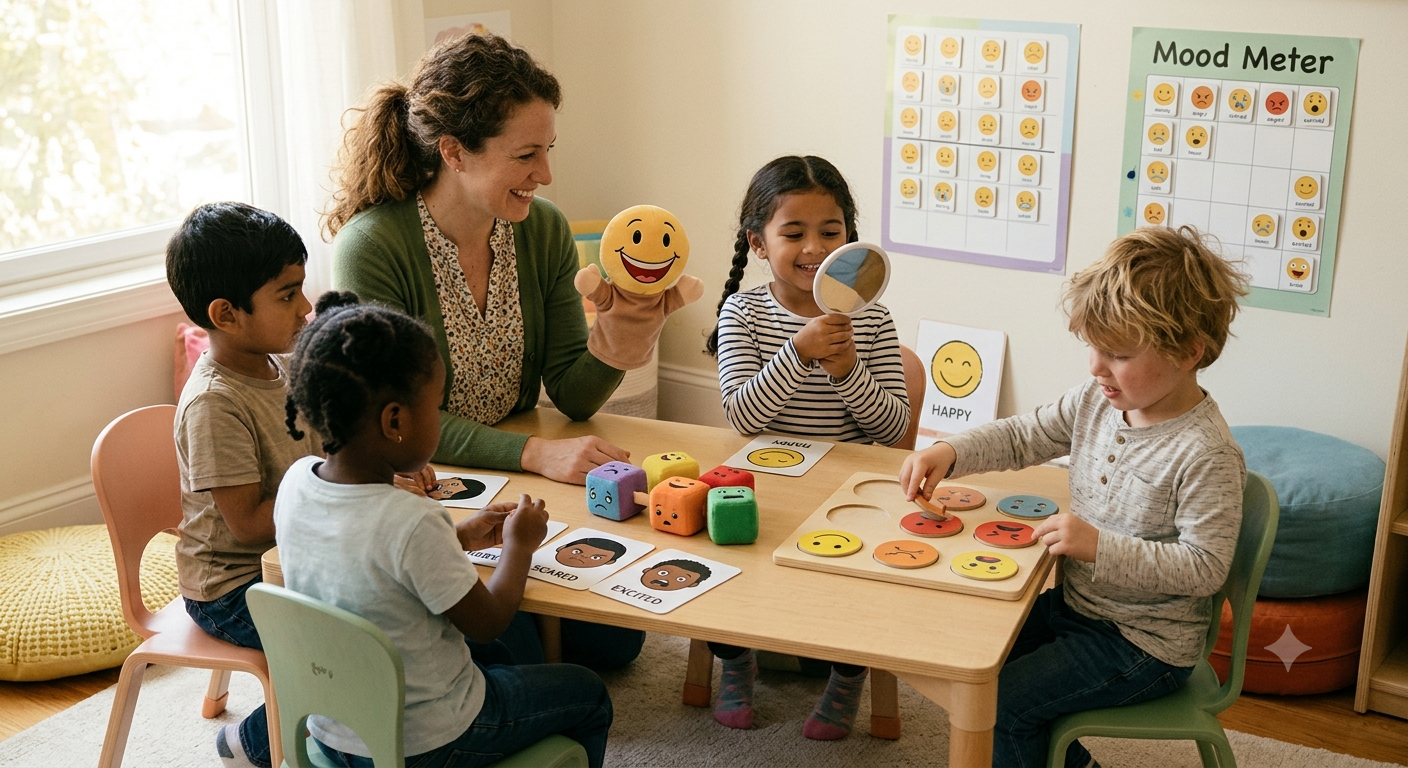
Emotion Picture Cards
Create cards with faces showing different emotions—happy, sad, angry, surprised, scared. Have children draw the faces themselves if possible. Use these cards to play games:
- Show a card and ask children to name the emotion
- Ask children to show you what that emotion looks like on their own faces
- Use the cards for a game of charades (act out the emotion without speaking)
The Feelings Wheel
The Feelings Wheel breaks emotions down into basic categories and then gets more specific . Start with the basics—happy, sad, mad, scared—and help children expand their vocabulary. Watch a clip from Pixar’s Inside Out to spark conversations about feelings .
Mirror Play
Put a mirror in your calming corner. When children visit that space, encourage them to use the mirror to notice how their emotions match the face they’re making . You can also:
- Pair mirrors with story time. Ask children to show an emotion that a character is feeling
- Play a game where you call out an emotion and children mimic it in the mirror
Matching Games
Create cards with emotion words and faces. Help children match the word to the expression. This builds vocabulary and critical thinking skills .
What I Learned:
We made an “emotions book” with pictures of my daughter making different faces. She loved looking at herself and naming the emotions. That book became her favorite—she’d bring it to me and say, “Show me happy!” Then she’d make the face. It was simple, but it worked.
Activities for Elementary School Kids (Ages 6-11)
By elementary school, kids have more emotional vocabulary and can handle more complex activities. These activities go beyond just naming feelings to understanding why we feel certain things.
Emotion Blocks
Use interconnecting plastic blocks to explore feelings. When a child names a feeling—like anger or fear—encourage them to choose a block that’s a good color and size for that feeling. Write the feeling word on the block.
As you work through what happened, add other feelings, choosing different blocks and connecting them. Some children may notice only two feelings, while others will name more .
The blocks help children organize their feelings and understand that we often have more than one feeling in a given situation. For example, a child who expressed anger about going to school might realize they actually feel anxious underneath the anger .
Emotions as Detectives
Show children photos of people displaying various emotions. Ask them to be “detectives” and identify which emotion is being shown. Guide the discussion: What clues did they use? Did they notice the eyebrows? The eyes? The mouth?
Take it a step further by showing pictures of scenarios—children playing at a playground or standing around a broken toy. Ask what emotion(s) the children in the pictures might be experiencing .
Self-Soothe Box
Create a “self-soothe box” that children can use when they have big feelings . This can include:
- A picture of family, pets, or happy memories
- A small toy like a teddy bear
- Playdough or a fidget toy
- A small puzzle
- A “hug jar” filled with hearts to give to someone when they need comfort
When children feel overwhelmed, they can go to their box and take what they need to calm down. This builds self-regulation skills.
Role-Playing and Puppet Shows
Use puppets to act out scenarios: two friends arguing over a toy, a child who’s feeling left out, or someone who’s nervous about a new situation. Ask children: “What would you do if you were Mr. Puppet? How could we help them?”
Journaling
For older elementary kids, journaling can help them process emotions. Prompt them with questions like:
What I Learned:
The emotions blocks activity was a game-changer for my daughter. She’d had an explosive tantrum over something small, and I realized later she was actually worried about a school situation. The blocks helped her untangle those feelings. She went from “I’m just angry” to “I’m angry AND scared AND frustrated.” That was huge.
Activities for Middle School and High School (Ages 11-18)
Emotional development doesn’t stop when kids hit adolescence. In fact, it becomes more complex. Teens face bigger social pressures, academic stress, and emotional ups and downs.
The Worry Iceberg
Help students understand that what we see on the surface isn’t always the whole story. Have them think about a situation that made them anxious. What could they see? What was happening underneath?
Fishbowl Discussions
Encourage active listening and communication skills with this technique. A small group of students discusses a topic while others watch and take notes. Then the discussion opens to everyone .
Positive Self-Talk
Model and reinforce positive self-talk. Use a self-talk poster with phrases like “I can do this” and “It’s okay to make mistakes.” Encourage teens to write encouraging messages to themselves .
Relaxation Techniques
Try yoga, meditation, or guided visualizations with teens. These activities develop physical and mental skills like deep breathing, balance, and mind-body connection—all of which aid in self-awareness and emotional regulation .
What I Learned:
The Worry Iceberg activity was surprisingly effective with my teenager. Instead of just being anxious about everything, he started identifying what was really underneath. Sometimes it was fear of failure. Sometimes it was feeling overwhelmed. Sometimes it was something else entirely. The iceberg helped him name it.
The Mirror and Photo Method
One of my favorite tools for all ages is using mirrors and photos to teach emotion recognition. It’s simple, effective, and kids love it.
Take Pictures of Your Kids: Take pictures of your child making faces that show different emotions. Label each one and display them around the house. These will serve as constant reinforcement of emotion recognition .
Emotion Detective: Show photos of people displaying various emotions. Ask children to be “detectives” and identify the emotions. What clues did they use?
Create a Class Emotions Book: Take pictures of students showing various emotions. In the captions, explain why they might be experiencing each emotion. This book will become a classroom favorite .
The Self-Soothe Box Project
This activity from the eTwinning program is brilliant . Here’s how to do it:
- Have children gather items that bring comfort—a picture of family, a small toy, a fidget, a puzzle.
- Create a “hug jar.” Children draw and cut out tiny hearts. They share hearts with each other and fill a jar. When a child has big feelings, they can go to the box and take a heart to give to someone when they need a hug .
- Include visual reminders of people, places, and memories that are important.
- Include soothing sounds or songs.
- Encourage children to use the box when they need to calm down or when they miss home.
The beauty of the self-soothe box is that it teaches children to recognize when they need support and gives them concrete tools to manage their feelings.
The Science Behind It All
Research backs up what many parents and teachers already know: play works.
A 2025 study on preschool-aged children found that play-based methods are the most effective approach to fostering emotional intelligence. Through role-playing and story-based games, children simulate real-life situations, experience both positive and negative emotions, and learn to understand others’ emotional states .
Activities like “The Theater of Emotions,” “The Dream of Colors,” and “I Understand My Friend” cultivate empathy, cooperation, tolerance, and positive communication .
Another 2025 study validated the importance of playful learning in promoting emotional development. Researchers found meaningful gains in empathy and self-control among students who participated in structured playful activities over 12 weeks .
The lesson is clear: children learn about emotions through experience, not explanation. Play is how they get that experience.
What I’d Tell a Fellow Parent
If you want to raise emotionally intelligent kids, here’s the most important thing I’ve learned: you need to get comfortable talking about feelings. Your own feelings. Your child’s feelings. The feelings of characters in books and movies. All of it.
Here’s what I’d say:
“Don’t wait for big emotional moments to talk about feelings. Make it part of everyday life. When you’re reading a book, ask how the character might be feeling. When you’re watching a movie, talk about the emotions on screen. When you’re having a tough day, name your own feelings so your child learns it’s okay to talk about them.
But here’s the key: when your child is in the middle of a meltdown, that’s not the time to teach. That’s the time to connect. Get down on their level. Acknowledge how they’re feeling. Then, when they’re calm, you can play through the situation and help them understand what happened.
And please, give yourself grace. You’re not going to get it right every time. I certainly don’t. What matters is that you’re trying—and that you’re showing your child that feelings are a normal part of being human.
At the end of the day, the most powerful tool you have is your own example. Your child is watching how you handle your emotions. Show them that it’s okay to feel big things and that there are healthy ways to work through them.“
Final Verdict
Teaching kids about emotions through play isn’t complicated. It doesn’t require expensive toys or elaborate lesson plans. What it requires is intention—the willingness to talk about feelings, to make space for emotional exploration, and to let your child lead the way.
I started this journey feeling like I was failing at emotional education. I finished it realizing that the most important thing I could do was simply be present, be curious, and be willing to play.
If you take one thing away from this article, let it be this: your child doesn’t need you to have all the answers. They just need you to be with them in their feelings. And sometimes, the best way to do that is through play.
Disclaimer: This article is based on my personal experience, research, and conversations with educators and child development specialists. It is not a substitute for professional mental health advice. If you have concerns about your child’s emotional development, consult with a qualified professional.
